Choice-Based Conjoint analysis | Flight tickets
Introduction
The goal of this Choice-Based Conjoint analysis is to get a better grasp of the regional market and travellers’ buying decisions when it comes to booking flight tickets.

Attributes and levels
In this specific analysis, I have retained 4 principal attributes with respectively 4, 3, 3 and 2 levels, which are depicted in the table below.
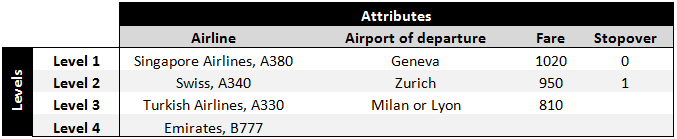
Here is how it works:
- A set of 3 different profiles is shown to the respondents, who will have to pick one of the three options displayed (click on the Survey tab above to see how it looks).
- The same process is repeated 12 times with different profiles in order to detect the buyer’s preferences.
Creating profiles
According to the book “Multivariate Data Analysis, 7th edition” in the chapter Conjoint Analysis, no more than 6 attributes should be used for a Choice-Based Conjoint Analysis and a minimum number of profiles is also required. As a matter of fact, 72 profiles are possible in this example if I were to use a full factorial design. That is 4*3*3*2 levels. As we cannot require respondents to go through all of them, a solution exists which consists in selecting only a subset of profiles. The method is called “fractional factorial design” and has to respect 2 important aspects:
- Orthogonality: avoiding correlations between levels of an attribute
- balanced design : the attribute’s levels appear the same number of time
Here is the formula with regard to the minimum number of profiles that have to be defined taken from the book aforementioned:
- Minimum # of profiles = Total # of levels across all factors - # of factors + 1
Choice-Based Conjoint analysis (CBC)
"Choice-Based Conjoint analysis (CBC), also known as Discrete Choice Modeling (DCM), looks at choices instead of ratings or rankings (CVA and ACA), which is considered to be more life like. It requires research participants to make a series of trade-offs by indicating their preferences within a controlled set of potential products or services. Analysis of these trade-offs will reveal the implicit valuation of individual elements making up the product or service – e.g. brand, package, price. ."