Statistical modelling • regression analysis for prediction
Pricing strategy: relationship between GDP and room rates
Introduction
As demonstrated in the attached picture, there is a correlation
between the price of a Big Mac and the GDP per person. The more you earn the more expensive your
Big Mac should be.
Based on this, I wanted to create my own index to see whether the Four Seasons and the
Ibis hotels' room rates could be explained by the GDP per person.
To get a better understanding of their pricing policy, I gathered their rates (1
night for 2 people in a standard room) and then converted them into USD to make comparisons.
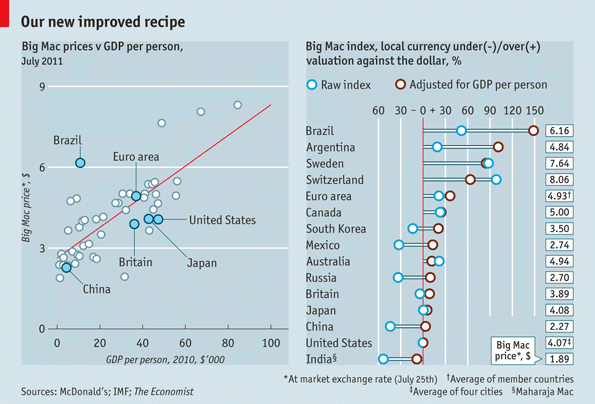
The Big Mac Index
The Big Mac Index is used as a world price index, to see the variation of prices between countries and measures the inflation worldwide.
Observations
No correlation.
We found out that the GDP per capita only explains 10% of the room
rates.
Statistically speaking, it is extremely weak.
Positive correlation.
We found out that the GDP per capita explains 53% of the room rates.
Statistically speaking, it is quite significant!
Four Seasons' data
Ibis' data
conclusion
On the one hand, we have The Four
Seasons that clearly targets wealthy customers who do not choose a room based on its
price. They are looking for a certain level of quality and service and will
pay a premium for that, wherever it is. The correlation between the GDP per capita and the room
rate being extremely weak, we can conclude that Four
Seasons does not set its prices based
on the GDP per capita.
On the other hand, the Ibis is targeting a wider
client base. Their customers tend to be more price sensitive. Therefore, they expect a price in
accordance with the local purchasing
power.
By not adjusting their price to the country of operation, Four Seasons clearly positions itself as a top end resort.
There is also an interesting question that we have not been
able to answer. Do Four Seasons hotels located in
developing countries generate more revenues than the one in Europe or North America and can they
help or subsidy the one where the labour
costs are higher?